
For purchasing & operations
Stop chasing suppliers by email
You send the order, and then the questions start. Did they get it? Did they accept the date? Did it ship? Why is the dock still empty? The answers exist in acknowledgments, ship notices, and packing slips, but they live in inboxes, so somebody chases them by phone. DynamoDocs turns that paperwork into a live picture of what suppliers have committed to, what's moving, and who actually delivers.
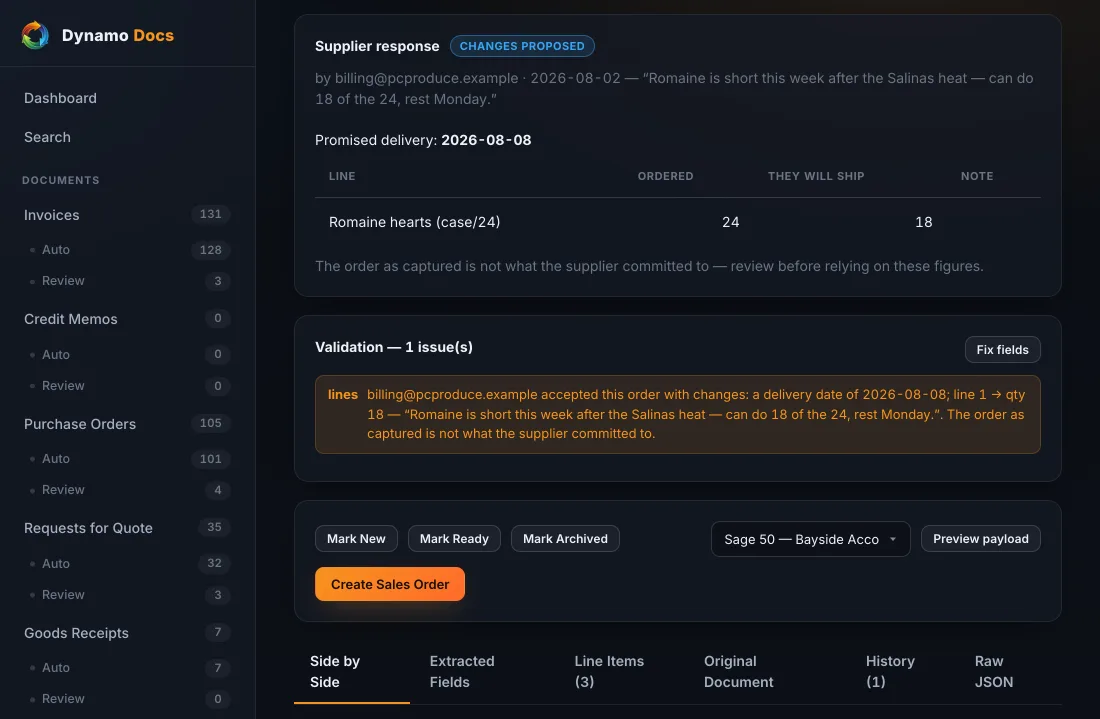
Every order gets an answer
Send a supplier a signed link and they confirm your order, adjust a date or a quantity, or decline, with no account and nothing to adopt. A confirmation as written changes nothing. An answer that changes the order is routed to review, so nobody plans production against a delivery date the supplier never agreed to. Suppliers on EDI keep sending 855s; the link covers everyone else.
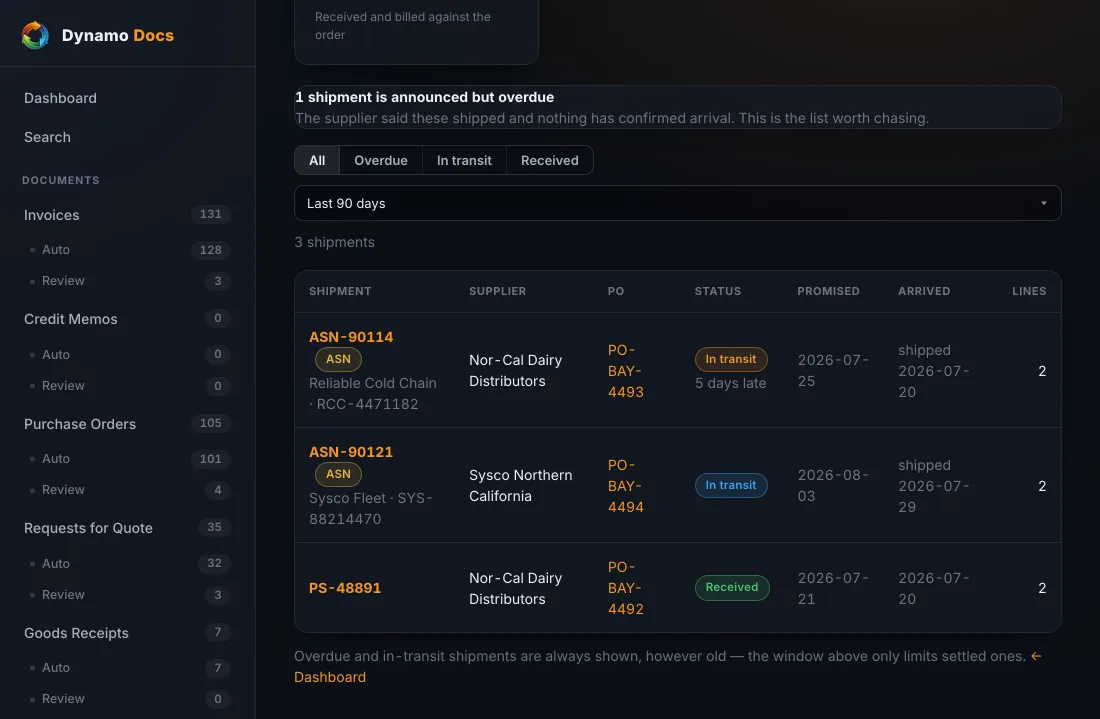
The dock knows what's coming
In transit, received, invoiced, and overdue at the top, with the carrier and tracking number. Lateness is measured against the date the supplier actually committed to, and a promise is never mistaken for a delivery. The shipment that's been missing for weeks stays on the board however old it gets, because that's the one that becomes a line-down call.
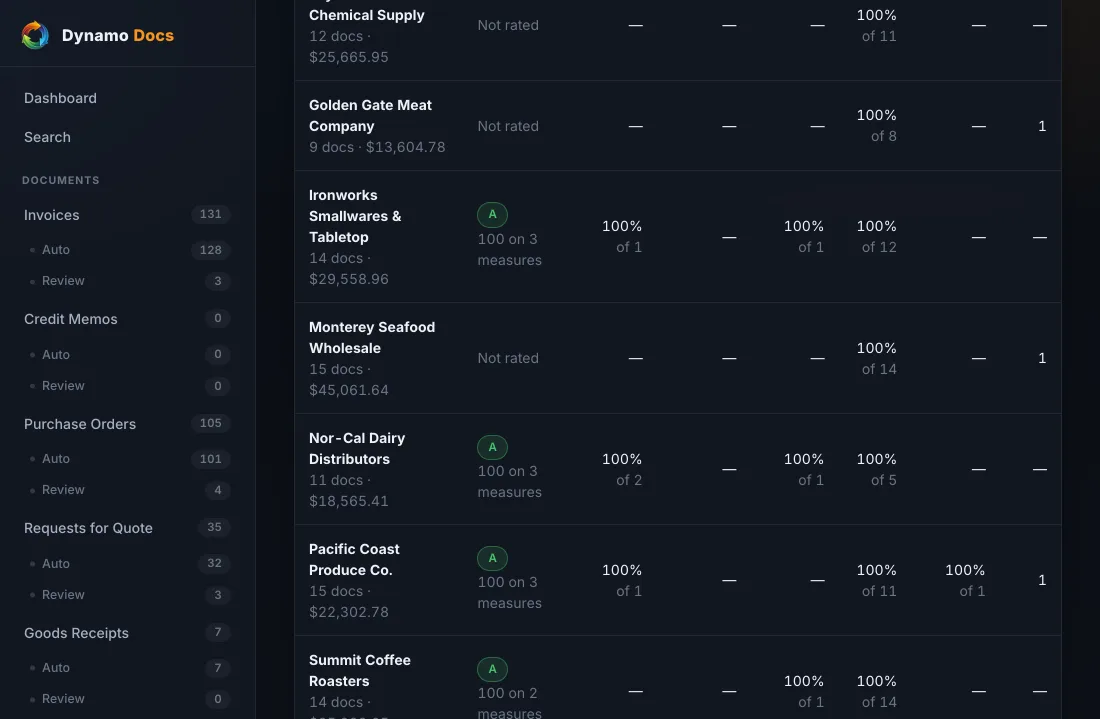
Negotiate with evidence, not anecdotes
Which suppliers deliver on time, ship complete, bill what was quoted, and answer when asked, scored from the documents themselves, with the observation count behind every rate. A measure with no evidence shows a dash, never a zero, so the scorecard stays fair enough to put in front of the supplier it describes. Every figure traces to documents you both hold copies of.
And the paperwork behind it
The same system runs your AP
The documents feeding the supplier picture are the same ones AP processes: captured once, used twice.
Three-way matching
An invoice must agree with the order and with what arrived at the dock, so you don't pay for the two cases refused for wilt. Only a shortfall raises an exception. Over-delivery is a warehouse question, not an AP one.
Price protection
An invoice billing above the PO's contract price is flagged before it posts, with both figures side by side. One customer caught 400+ billing discrepancies in four months.
EDI without a second system
850 out, 855/856 back, 810 in, through SFTP, AS2, or the VAN folder you already have. EDI partners and email-a-PDF suppliers land in one queue.
The paper trail, connected
From an invoice: the order it bills and the deliveries against it. From a packing slip: the invoice it supports. Computed live, because the relationship forms when the second document arrives.
Questions
What purchasing teams ask
Do our suppliers need to install or join anything?
No. A supplier gets a link scoped to one order and one contact, answers on a single page, and is done. No account, no password, no app. That is deliberate: portals fail on the long tail of suppliers who will never maintain a login for one customer, and the long tail is where the surprises come from.
We already get EDI 855s from our big suppliers. What does this add?
The rest of your supplier base. EDI-capable partners keep using EDI, and DynamoDocs reads their 855s and 856s natively. The response link covers everyone else: the produce vendor, the local fabricator, the supplier who answers orders by replying to an email. Both paths land in the same place, on the order, with the same exception handling.
Where does the shipment and scorecard data come from?
From documents already being captured for AP: purchase orders, advance ship notices, packing slips, and invoices. Nothing extra is keyed in and no separate feed is maintained, which is why the numbers stay current after the first month, unlike a hand-fed spreadsheet.
Book a working session, not a sales call
Bring two or three of your real documents: your ugliest invoice, a customer PO, an EDI file. In 30 minutes we'll run them through extraction, validation, and a mapping to your ERP, live. You'll leave knowing exactly what your rollout would look like, and you'll get the founder, not a sales team.